
If you’ve started looking into solar panels, one question tends to pop up straight away: how many panels will actually fit on my roof and will they cover my bills?
It’s a great question, because there isn’t one “standard” answer. Two homes on the same street can need totally different system sizes, simply because their electricity use, roof shape, shading, and panel choice are different. Even the direction your roof faces can change the amount of energy your panels generate.
In this guide, we’ll break it all down in plain English, from how to check your electricity use to how panel wattage changes the number of solar panels you need, to the common roof and grid limits that can affect the final design. And yes, we’ll answer the big question: “How many solar panels do I need?” with simple formulas and real UK reference numbers.
Why would you switch to solar panels in the first place?
Solar isn’t just about being greener (although that’s a nice bonus). For most homeowners, it’s about saving money, gaining control over energy bills, and making your home more future-proof.
You can cut your electricity bills with power from your own roof
Solar PV panels capture sunlight and convert it into electricity you can use in your home. Once they’re installed, the electricity they generate is essentially “free” at the point of use, so the more you use at home during the day, the more you can reduce what you buy from the grid.
Solar panels also work on cloudy days (you’ll generate less than in full sun hours, but you’ll still generate).
This is because solar panels generate electricity directly from daylight rather than heat. Even when the sky is overcast, sunlight still reaches the panels and can be converted into usable power. The stronger the daylight, the more electricity your system will produce.
You may be paid for exporting spare electricity
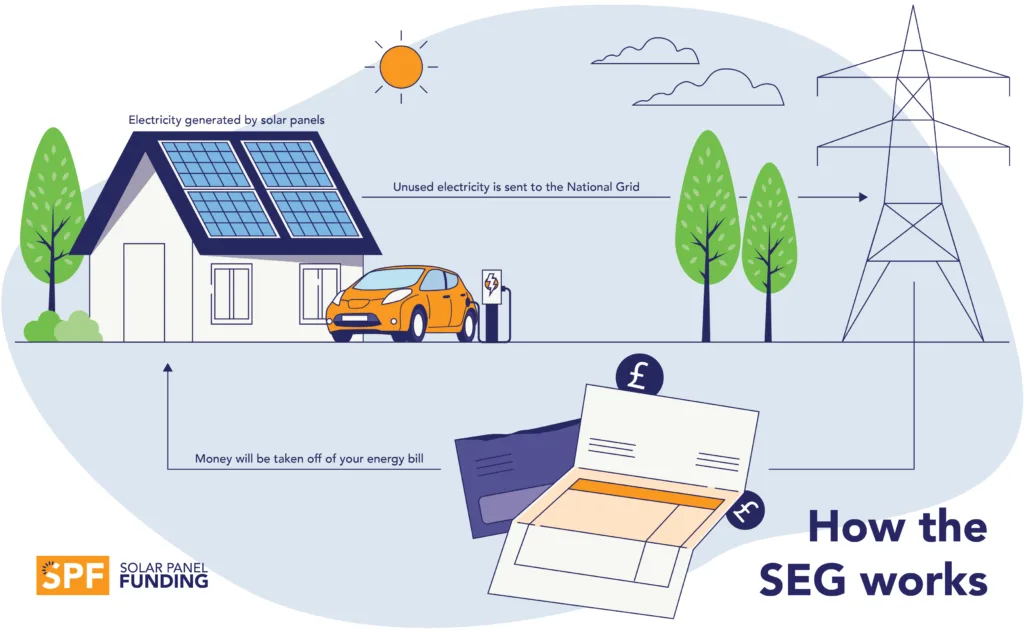
When your system generates more electricity than your home is using at that moment, the excess can be exported to the grid. In Great Britain, the Smart Export Guarantee (SEG) is the government-backed framework that requires SEG-licensed suppliers to pay eligible small-scale generators for exported low-carbon electricity.
You reduce your home’s carbon footprint
Solar electricity is a renewable energy consumption source. Energy Saving Trust notes that a typical home solar system can save around one tonne of carbon per year, depending on where you live in the UK, using the power generated by your solar panels.
The biggest factors that decide how many panels you need
Before anyone can give a reliable number, you need to know what’s driving the calculation. In practice, your panel count is usually shaped by four main things:
- Your usage
- Your roof
- Your panel choice
- Your location
Your electricity use is the starting point
The simplest way to think about solar sizing is:
More electricity used = larger system needed = more (or higher-wattage) panels.
Ofgem publishes Typical Domestic Consumption Values (TDCVs) to explain low, medium, and high household electricity use. As an easy reference point, Ofgem’s examples show:
- Low use (flat or 1-bed; 1–2 people): ~1,800 kWh/year
- Medium use (2–3 bed; 2–3 people): ~2,700 kWh/year
- High use (4+ bed; 4–5 people): ~4,100 kWh/year
How panel wattage and efficiency affect system size and roof space
Solar panels come in different power ratings (often shown as watts, like 350W or 450W). As a rough rule: higher-wattage panels can mean fewer panels for the same system size, which is helpful if roof space is tight.
Efficiency is related, but slightly different. Efficiency is basically how well a panel turns sunlight into electricity, relative to its size. Higher efficiency often means more power from the same amount of roof space.
Roof direction, pitch, and shading affect performance
Even if you have loads of roof space, the usable roof area (without heavy shade, awkward angles, or obstructions) matters.
Energy Saving Trust notes:
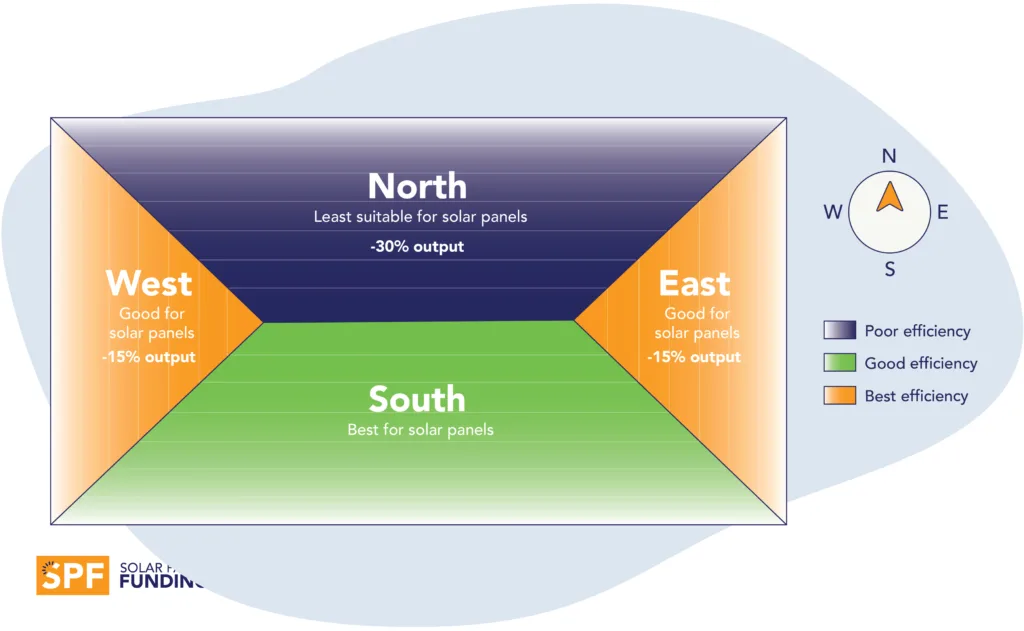
- An unshaded, south-facing roof is ideal for maximum performance.
- East- or west-facing roofs still work, but they tend to generate around 15–20% less energy than a south-facing roof.
- They don’t recommend installing panels on a north-facing roof.
Where you live in the UK changes the annual output
The same system size won’t generate exactly the same energy in every region. A widely used rule-of-thumb in the UK is that 1 kW of solar panels generates roughly 800–1,000 (kilowatt hours) kWh per year, depending on siting and location.
Types of solar panels and what “performance” really means
Most homeowners don’t need to become solar engineers, but you do want to understand the basics, because the panel type can affect how many panels you need, especially if your roof is small.
In simple terms, the differences come down to efficiency, appearance, and cost.
Monocrystalline panels
Monocrystalline panels are widely considered the highest-efficiency mainstream option for homes, which makes them popular when roof space is limited. Consumer solar guides commonly place monocrystalline efficiency in the high-teens to low-20% range, depending on the model.
When they’re a good fit: You want to maximise generation from a smaller roof area.
Polycrystalline panels
Polycrystalline panels are generally described as slightly lower efficiency than monocrystalline in many consumer references.
When they’re a good fit: You have decent roof space and the price difference is attractive (availability varies by installer and stock).
Amorphous panels
Amorphous panels, aka thin-film panels, are typically described as lower efficiency than mono/poly in consumer summaries, which usually means you need more roof area for the same power output.
When they’re a good fit: Thin-film panels can be flexible, which means they can sometimes be installed on curved surfaces or in awkward spaces where rigid panels would not work.
A key takeaway: when you’re working out “how many solar panels do I need”, you’re not only choosing a number, you’re choosing a mix of panel power rating + efficiency + roof space that needs to work together.
How to calculate the number of solar panels you need
Let’s make this practical. Here’s the simplest homeowner-friendly way to estimate your panel count.
Find your annual electricity use in kWh
Look for your household’s annual electricity usage in kWh. You can usually find it:
- On your annual statement
- In your online energy account/app
- On a bill (often showing usage for the period; you can total 12 months)
If you don’t have it, you can at least benchmark against Ofgem’s typical values (low/medium/high).
Estimate how much energy a UK solar system produces per kW
A common UK planning rule-of-thumb is:
- 1 kW of solar panels → ~800 to 1,000 kWh per year
To keep your first estimate simple (and realistic), many people use ~900 kWh per kW per year as a middle-of-the-road working number, then adjust after a proper roof survey. This assumption fits inside the 800–1,000 range cited above.
Convert your annual kWh into a suggested system size in kW (kWp)
Here’s the basic logic:
- Estimated system size (kW) = Annual electricity use (kWh) ÷ 900
(We’re using 900 here as a mid-range UK estimate; your real number will vary.)
Example (medium household): – Annual use = 2,700 kWh
System size ≈ 2,700 ÷ 900 = 3.0 kW (roughly)
Convert system size into number of panels
Now take the system size and divide by panel wattage.
- Number of panels = (System size in kW × 1,000) ÷ Panel wattage
So for a 3.0 kW system:
- With 350W panels → (3.0 × 1000) ÷ 350 ≈ 9 panels
- With 450W panels → (3.0 × 1000) ÷ 450 ≈ 7 panels
That’s why panel choice matters so much when people ask how to determine how many solar panels I need. The same home might be quoted 7 panels by one installer and 9 by another, simply because the panel wattage and layout differ.
A simple UK guide table you can use as a starting point
| Household size (typical example) | Example home size | Typical annual electricity use (kWh) | Estimated panels needed (350W or 450W) |
| A | 1–2 bedrooms | ~1,800 kWh | ~4–8 panels |
| B | 2–3 bedrooms | ~2,700 kWh | ~7–12 panels |
| C | 4–5 bedrooms | ~4,100 kWh | ~10–16 panels |
Why ranges, not exact numbers? Because your roof direction, shading, region, and the exact panel wattage all change the final design.
Roof and installation limits that can affect your final panel count
Even if your calculations say you want 12 panels, your roof and local rules might push the design up or down.
Roof space and layout
Energy Saving Trust states the average home solar system is around 3.5 kWp, and that a 3.5 kWp system typically uses six to 12 panels and covers around 10 to 20 m² of roof area.
This is useful because it gives you a “reality check”:
- If you’re aiming for a standard family-sized system, you’re often looking at roughly a 10–20 m² footprint.
Panel dimensions vary, but consumer sizing guides commonly describe a typical residential panel as roughly 2m × 1m (about 2 m²).
Roof weight limits and structural checks
Most homeowners never need to worry about roof strength, but it is something a reputable installer checks, especially if your roof is older or has been repaired multiple times.
As a rough guide, many consumer references put the weight of an average residential solar panel around 16–20 kg, and note that mounting equipment adds extra weight too.
What you can do:
- Ask for a proper roof assessment as part of your quote/survey.
- If you’ve been told your roof has structural issues, fix those first. It’s rarely worth installing panels on a roof that may need major work soon.
Planning permission rules (most homes won’t need it, but check)
In many cases, roof-mounted solar panels fall under permitted development. But there are conditions, and exceptions apply in protected circumstances.
- On a pitched roof, panels shouldn’t be above the highest part of the roof (excluding chimneys), and they should project no more than 200mm from the roof slope or wall surface.
- On a flat roof, the highest part of the equipment can be no more than 600mm above the highest part of the roof (excluding chimneys).
- Extra restrictions can apply for listed buildings, scheduled monuments, and some conservation-related situations.
Grid connection limits (yes, the grid can affect “how many”)
This one surprises people: your roof might fit 16 panels, but your grid connection process can change what’s allowed without extra paperwork or upgrades.
MCS explains that if Engineering Recommendation G98 applies (commonly smaller systems), the DNO needs to be notified within 28 days of commissioning; if G99 applies (larger systems), prior permission to connect is required.
National Grid’s guidance also describes G98 as a micro-generation connection route for fully type-tested installations under 16A per phase, using a “fit and notify” approach.
What this means in real life: when you ask how many solar panels do I need, the best installers won’t just count panels, they’ll design a system that also works cleanly with your property’s electrical setup and DNO requirements.
Costs, savings, and how funding can help
Once you have a rough panel number in mind, the next natural question is cost.
What does a typical UK roof solar system cost?
Energy Saving Trust states that an average home solar panel system costs around £6,100 to install (costs vary by system size and property specifics).
MoneySavingExpert also references the typical 3.5 kWp system price at about £6,100, based on Energy Saving Trust figures, while stressing you should “do the numbers” for your own home.
VAT relief can reduce the upfront cost
The UK introduced a temporary 0% VAT rate on installations of certain energy-saving materials (including solar panels) until 31 March 2027, after which installations are set to revert to the reduced 5% rate. (See GOV.UK’s VAT energy-saving materials relief extension.)
Grants and funding aren’t one-size-fits-all
Funding availability depends on your circumstances, where you live, and which schemes are open.
If you’re exploring solar but are concerned about the upfront cost, our quick eligibility checker can help you see whether you may qualify for solar panel grants or funding. It only takes a minute to complete, and once submitted, our team can review your details and talk you through the options that may be available to you.
How Solar Panel Funding can help you get a system sized for your home
If you’re worried about overbuying (or underbuying) a solar system, the best next step is a proper assessment based on your postcode, roof, and usage.
Our Quick & Easy Funding Checker is designed to help you see whether your postcode may qualify for solar panel grants or other funding. It only takes a minute to complete, and once you submit the form, our team will review your details and get in touch to talk through the options that may be available to you.
Depending on your eligibility, this could include fully funded solar panels for qualifying homeowners, finance options through our trusted installer network, or the option to purchase a system outright. All options are subject to eligibility checks and a full assessment.
Summary and next steps
There’s no magic number fits everyone, but there is a simple way to get very close.
If you’ve made it this far, you already know more than most first-time buyers, and you’re in a strong position to avoid getting upsold or undersized.
If you want help getting a system designed around your roof and budget, Solar Panel Funding’s eligibility checker is designed to quickly show what funding or grant-style options may be available in your area, with follow-up support to discuss the cheapest routes for your postcode.